
Why Self-Flagging Can Put Crews at Risk
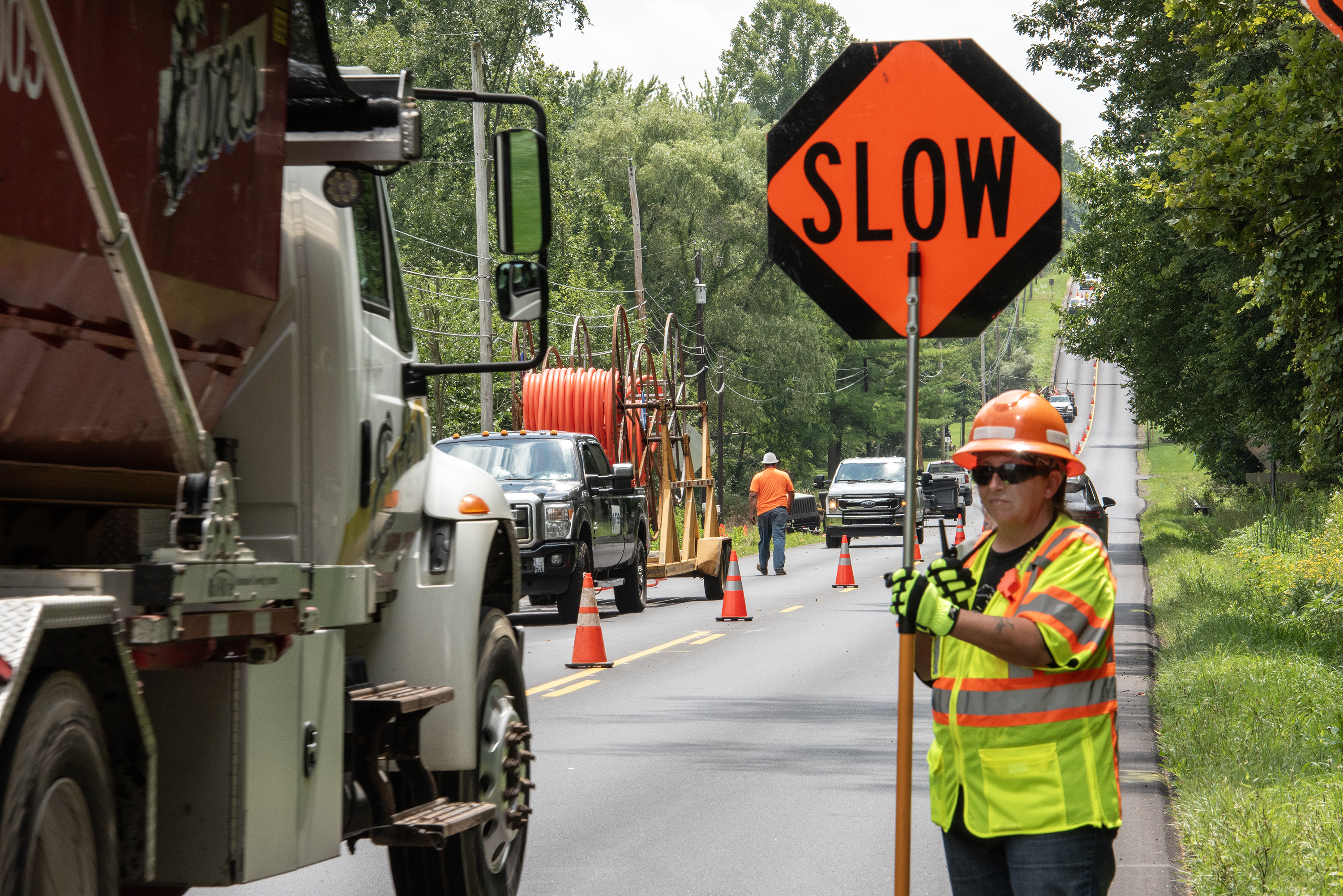
AWP Flagger Slow
AWP Safety treats flagging (Protecting) as a dedicated role with specific positioning requirements.
Damage prevention is built on discipline. You verify the ticket, respect the marks and excavate carefully because one shortcut can create a strike, outage or serious injury.
That same discipline needs to show up above ground.
Because a lot of underground work—potholing, service drops, curb boxes, vault access and those quick repairs that are “only going to take a few minutes”—happens in live traffic. Those are also the jobs where crews most often self-perform traffic control, and sometimes self-flag.
When crews self-flag, traffic control can become a second job layered onto active field tasks, which reduces situational awareness.
Below is AWP Safety’s advice for excavators and contractors who want to reduce exposure without slowing work down.
The biggest issue is split attention
Flagging requires full attention, steady scanning and quick decision-making. Excavation tasks require focus, tool control and awareness of the crew and equipment. Locating and potholing require precision and documentation.
One person can only give full attention to one critical task at a time, and self-flagging often forces crews to split focus in ways that show up on short-duration jobs:
- Traffic scanning becomes intermittent as the flagger is momentarily distracted by other demands (communications, staging, tool handling, documentation, coordination).
- Positioning drifts toward convenience, or standing where it’s easiest to monitor the work, not necessarily where approaching drivers have the clearest view and earliest reaction time.
- Familiarity creates false confidence because “nothing has happened yet,” even when conditions (speed, volume, sight lines) haven’t improved.
- Close calls get normalized, where a near miss becomes “part of the job,” rather than a trigger to stop, reset the setup and reassign roles.
Self-flagging can also increase worker exposure precisely where driver error is most dangerous. The person holding the paddle may be a crew member who’s competent at excavation work but hasn’t had formal, role-specific traffic control training, meaning they may not fully understand work zone layout fundamentals, safe positioning or how to read driver behavior and intervene early.
What to do instead
Self-flagging is common, but that does not mean it is the best option. The goal is to design the risk out of the job with a few repeatable standards:
1. Treat traffic control as its own job
If the job needs flagging, assign a dedicated flagger (a Protector) who’s trained specifically for traffic control and proper practices. Never combine flagging with other active tasks.
2. Build the work zone as a five-part system (defend the buffer!)
Per the FHWA’s Manual on Uniform Traffic Control Devices for Streets and Highways (MUTCD), a compliant work zone consists of five sections: 1) advance warning, 2) transition, 3) buffer space, 4) workspace, and 5) termination.
The buffer space is there to separate traffic flow from the workspace and provide recovery space for an errant vehicle. The buffer space is “EMPTY SPACE.” Do not stand in it. Do not park in it. Do not store equipment or material in it. If the site is too tight to keep the buffer empty, you may need a different plan, staging or sequencing.
3. Run a hazard assessment before work starts
Tie risk control back to hazard assessment through a pre-job safety briefing. Even for short-duration work, that briefing needs to be comprehensive. Cover traffic speed and volume, sight lines, where trucks and equipment will stage, how backing will be handled, what conditions trigger a stop and reset, what the day’s weather forecast has in store, as well as escape routes in case of a work zone intrusion.
4. Control risk around the work zone
Underground utility work involves constant repositioning and backing, and backing accidents represent one of the most preventable driving-related risks. Crews should avoid backing whenever possible and use spotters every time a company vehicle must be put into reverse, maneuvered out of a tight spot or loaded on a trailer.
Planning gaps become compliance gaps
Damage prevention culture comes with heavy documentation for a reason. If something goes wrong, the question is not only “what happened?” It is also “what was the plan and did you follow it?”
Traffic control is similar. After an incident or complaint, reviewers will ask:
- Was there a traffic control plan or a short-duration standard?
- Were advance warning and tapers set correctly?
- Was buffer space kept empty?
- Was the flagger positioned in a visible location?
Proper work zone training will call out a proper flagging position as crucial and will state that flaggers are required to stand in clearly visible spots on the shoulder while avoiding areas with poor visibility like curves, hills or shade.
That is hard to do when the same person is also watching a pothole, managing hose movement and coordinating with the crew. Improvised setups also tend to leave weak documentation, which increases liability risk after the fact.
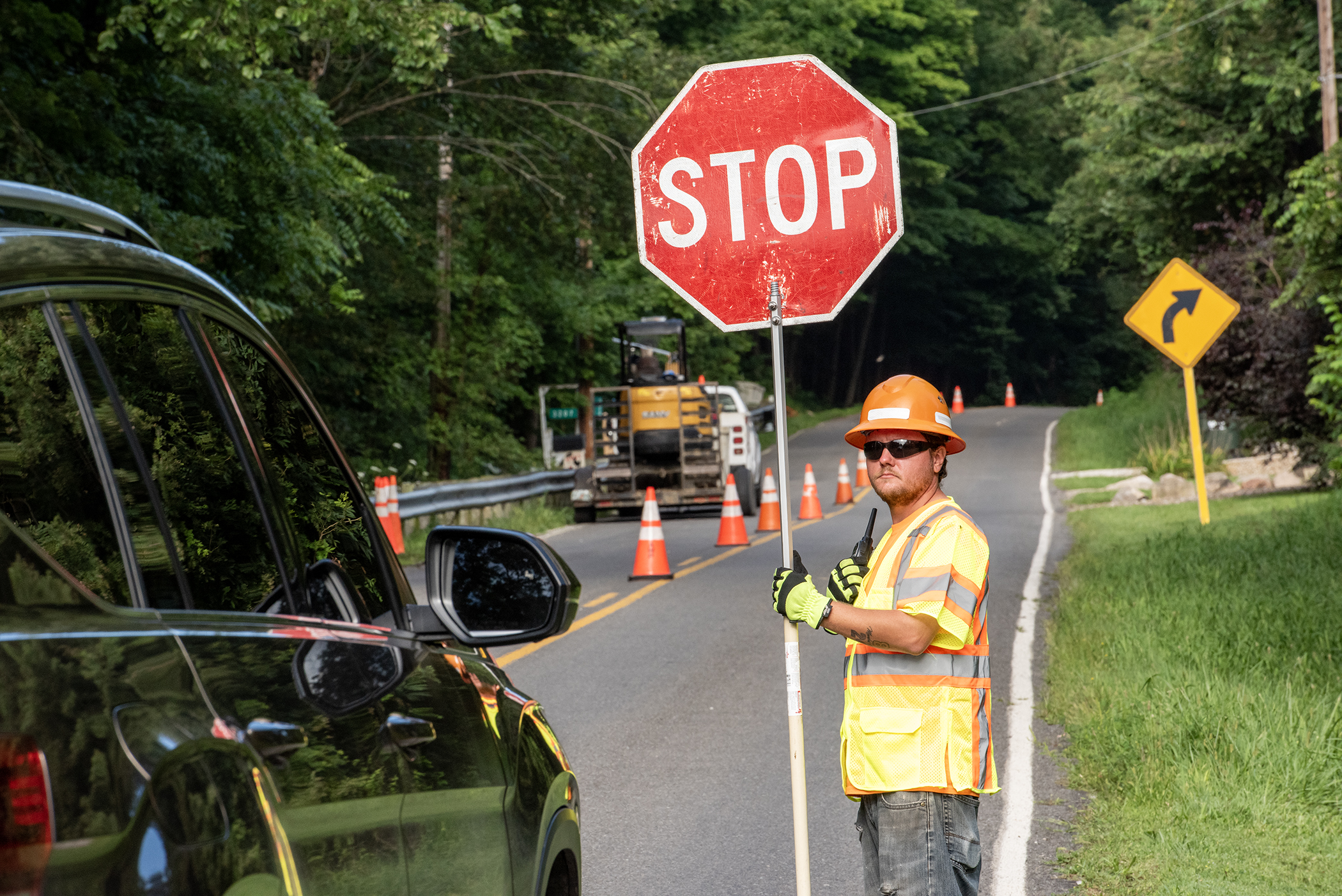
AWP Flagger Stop
Short-duration utility work often happens inches from live traffic. Dedicated traffic control and clear sight lines help keep crews focused on safe digging while drivers get unmistakable guidance.
When to bring in certified professionals
Not every excavation job needs external traffic control support, but many do. Bring in trained traffic control professionals when any of these conditions exist:
- The work is on a roadway where speeds are high, or traffic volume is heavy.
- The setup requires lane closures, tapers or complex transitions.
- Sight lines are limited by road geometry or jobsite obstructions.
- The job requires repeated mobilization, staging or backing near live lanes.
- The crew cannot maintain buffer space as empty recovery space.
Also consider support if the scope or site constraints make it challenging to maintain clear documentation of traffic control decisions and adjustments. If you cannot show a plan, a setup standard and a clear separation of duties, the risk is already too high.
Extend safety culture above ground
Damage prevention is a culture of discipline, and it is not a single best practice, but a complete system. Traffic control is the same.
If your organization already believes in prevention below ground, apply that belief above ground. Use the five-part work zone model as your setup checklist. Protect the buffer as empty space. Run the hazard assessment every time. Assign a trained flagger whose only task is watching traffic. And always treat backing as a high-risk event.
Self-flagging feels normal because it is. That does not make it safe.
When team members go home at night, damage prevention wins twice. It protects the infrastructure and it protects the people doing the work.
Learn more about safer work zone management at awpsafety.com.
This article was written by:

Ryan Dobbins
Ryan Dobbins is AWP Safety’s Vice President of Environmental, Health and Safety (EHS),
focused on advancing injury prevention through proactive, data-informed safety leadership
and stronger alignment between operational execution and worker protection.